
 August 27, 2026
AEO Is the New SEO: How to Get Cited by ChatGPT and AI Overviews
AI answer engines like ChatGPT, Perplexity, and Google AI Overviews are becoming the new front door for buyer research. Here's…
Read more →August 19, 2026
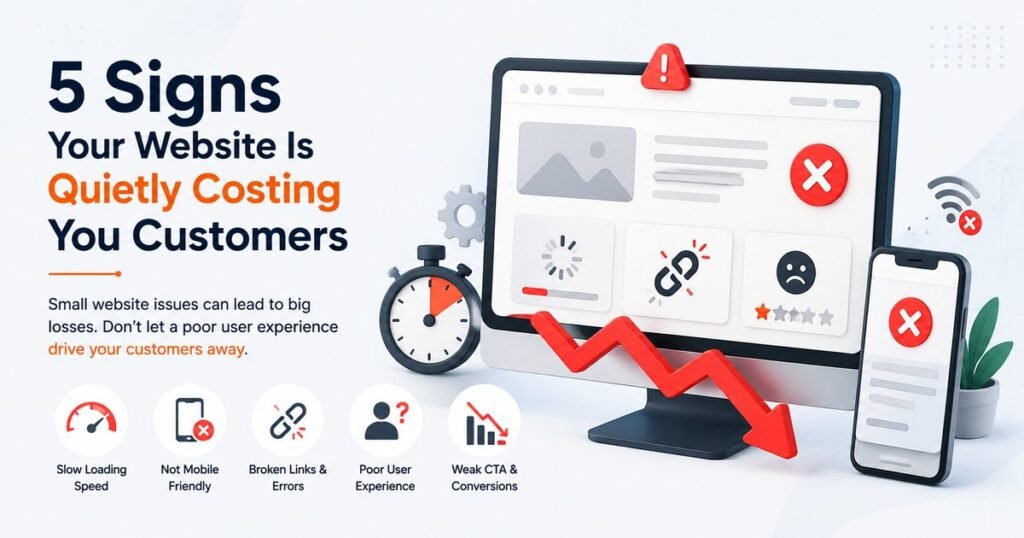
Most underperforming websites don’t look broken — they load, the design is fine, nothing throws an error. They just quietly leak revenue every day in ways a casual glance never catches. Here are five patterns we flag constantly during free audits, and what to actually do about each one.
Over half of mobile visits get abandoned once load time crosses roughly three seconds — a pattern Google’s own research on mobile behavior has documented repeatedly. The usual causes are unoptimized hero images, render-blocking fonts, and plugin bloat on WordPress sites. Run your homepage through PageSpeed Insights; if the mobile score is under 70, that’s lost revenue, not a vanity metric.
If a first-time visitor can’t tell what to do in the first five seconds — book a call, start a trial, add to cart — they leave and don’t come back. Every key page needs exactly one primary action, visually dominant, with everything else demoted to secondary.
A tight, five-field form with clear context on what happens next consistently outperforms a generic ten-field plugin default. Ask only for what you genuinely need to make the first call or email useful — name, contact detail, and what they’re looking for is usually enough to qualify a lead.
Testimonials, client logos and real numbers work because they resolve doubt at the exact moment someone is deciding — which means they need to sit next to the call-to-action, not on a separate “Testimonials” page nobody navigates to.
Pageviews and session counts aren’t revenue. If you can’t currently name the marketing channel that produced your last five qualified leads, you’re optimizing blind — and every dollar of ad spend after that is a guess dressed up as a strategy.
None of these require a full rebuild. Most are a focused two-to-three week sprint once you know exactly what to fix — which is the entire point of a proper audit instead of a generic PDF report.
August 27, 2026
AI answer engines like ChatGPT, Perplexity, and Google AI Overviews are becoming the new front door for buyer research. Here's…
Read more → August 11, 2026
WhatsApp routinely sees 90%+ open rates, yet most businesses treat it as an afterthought. Here's a practical playbook for turning…
Read more →Get a free audit of your current marketing and website — no obligation, just a clear plan.
Book a Free Strategy Call